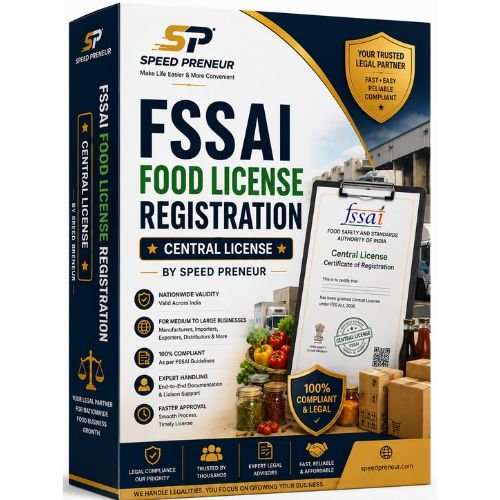
FSSAI Central License (Excluding Govt. Fees) (GOV FEES EXTRA)
FSSAI Central License (Excluding Govt. Fees)
The Food Safety and Standards Authority of India (FSSAI) is responsible for regulating and overseeing food safety in India. FSSAI Central License is a mandatory requirement for food businesses that operate in more than one state or union territory or have an annual turnover of more than Rs. 25 crore.
The purpose of FSSAI Central License is to:
- Ensure that food businesses that operate in more than one state or union territory are complying with food safety regulations.
- Promote food safety practices among food businesses that operate in more than one state or union territory.
- Protect public health from foodborne illnesses across India.
There are several benefits to obtaining FSSAI Central License, including:
- Legal compliance: Registered food businesses are legally compliant with FSSAI regulations, which helps to protect them from legal action.
- Consumer confidence: Consumers are more likely to trust food businesses that are licensed by the FSSAI.
- Improved food safety practices: Licensing encourages food businesses to adopt better food safety practices, which helps to reduce the risk of foodborne illnesses.
- Access to government schemes: Licensed food businesses are eligible for various government schemes, such as financial assistance and training programs.
Validity of FSSAI Central License
FSSAI Central License will be issued for 1 to 5 years, as chosen by the Food Business Operator, from the date of issue of registration or license. The Food Business Operator must apply for renewal 30 days before the expiry of the current request.
- The nature of the food business: Food businesses are classified into different categories based on the type of food they produce or handle. For example, food businesses that produce or handle meat, dairy products, or bakery products have different licensing requirements.
- The size of the food business: Food businesses are also classified into different categories based on their size. For example, micro, small, and medium-sized food businesses have different licensing requirements.
- The location of the food business: Food businesses that operate in multiple states or that import or export food products have different licensing requirements.
Differences between the Types of FSSAI Licenses
The following table summarizes the key differences between the different types of FSSAI licenses:
| Type of License | Annual Turnover | Required for | Issued by |
|---|---|---|---|
| Basic Registration | Up to Rs. 12 lakh | Small-scale food businesses | State or central licensing authority |
| State License | More than Rs. 12 lakh | Medium-scale and large-scale food businesses operating within a single state | State licensing authority |
| Central License | More than Rs. 12 lakh | Medium-scale and large-scale food businesses operating in multiple states or that import or export food products | Central licensing authority |
Conclusion
FSSAI Central License is an important requirement for food businesses that operate in more than one state or union territory or have an annual turnover of more than Rs. 25 crore. It is a simple and inexpensive way to ensure that food businesses are complying with food safety regulations and protecting public health across India. The type of license required depends on the annual turnover of the food business, the nature of the food.
Document Required
- Passport Size Photograph
- Trade Name and product & Service Description
- Passport size photo Self attested
- Pan Card self-attested
- Mobile Number
- Email Id
- IE Code document issued by DGFT
- DeclarationForm (By mentioning Estimated Annual Turnover)
- Gst certificate/Msme certificate
- Business Address (full with Pincode)
- Electricity bill/ Rent Agreement/ Sale deed/ NOC
- NOCs from Municipality or local body (depend on case) E.g–Meat, Dairy,Fish
- Licence for specific trade (E.g.- Drug & Pharmaceuticals)
- Blueprint / layout plan of processing unit (mandatory for manufacturing & processing unit)
- Name & List of Equipments and Machinery (mandatory for manufacturing & processing unit)
- Analysis Report of water (mandatory for manufacturing & processing unit)
- Source of Raw Material for meat
- Certificate provided by Ministry of Tourism (mandatory for Hotel Only)
- Self declaration of number of vehicles ( mandatory for Transporter Only)
- Incorporation Certificate ( Optional for Proprietorship firm)23.Minsitry of Commerce Certificate for 100% EOU
- Proof of Turnover
- Aadhar card- Self Attested